Some projects don’t start with a brief.
They start with a conversation.
Polka Café was one of those. The owners are close friends of my elder brother, and what began as a casual chat quickly turned into a serious question:
“We have a busy property at Neelkanth Mutual. Can we build a bakery that really stands out?”
That single question set the direction for everything that followed.
From inspiration to intent
The clients shared a few inspirational images—references, moods, and ideas they were drawn to. Instead of jumping straight into finishes or colours, we first translated those references into modules using our manufacturing software. This allowed us to design with real-world constraints in mind from day one.
Before finalising anything, we spent hours understanding:
- the structure of the space
- customer movement and usability
- display requirements for baked goods
- operational flow behind the counter
Only after this deep dive did a clear design language emerge.
Curves as a design statement
With exposure to cafés and retail spaces across different parts of the world, one idea kept coming back to us: curves.
Curves soften a space.
Curves invite movement.
Curves break the rigidity of typical retail joinery.
So we made curves the hero.
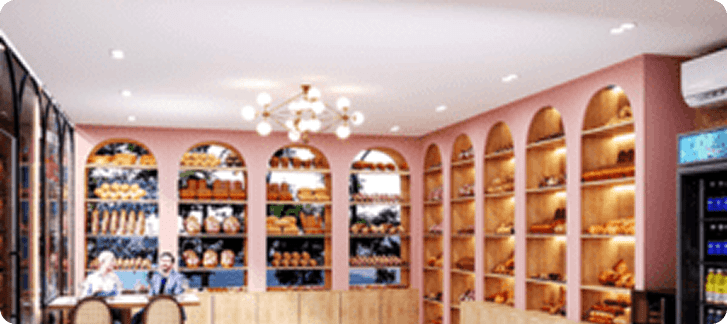
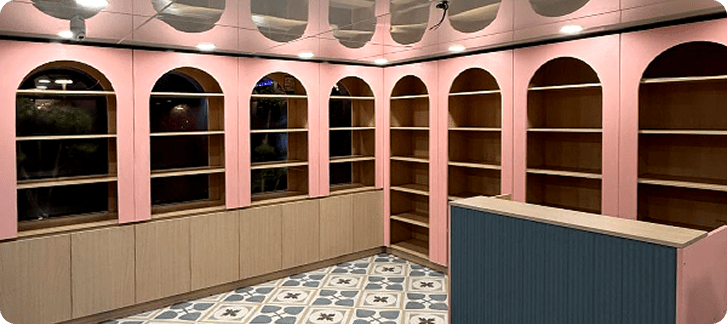
Arched niches, curved cabinets, and soft vertical lines were designed to frame the products rather than overpower them. The bakery items sit within the architecture, becoming part of the visual rhythm of the space.
Breaking branding barriers with AI
One of the first big discussions was around branding.
Polka Bakery didn’t want to follow a predictable bakery aesthetic. They wanted to break barriers—and so did we.
Here’s where AI became a powerful design partner.
After creating a rough 3D model in our manufacturing software, we used a set of tried-and-tested AI prompts to generate:
- eye-catching visualisations
- multiple mood directions
- fast iterations of colour, lighting, and material combinations
AI didn’t replace design thinking—it accelerated it. It helped us test ideas quickly, challenge assumptions, and present visuals that sparked confident decisions from the client.
Design beyond looks: context matters